
Blog
Subscribe to our NEWSLETTER to receive news, updates, and valuable tips.
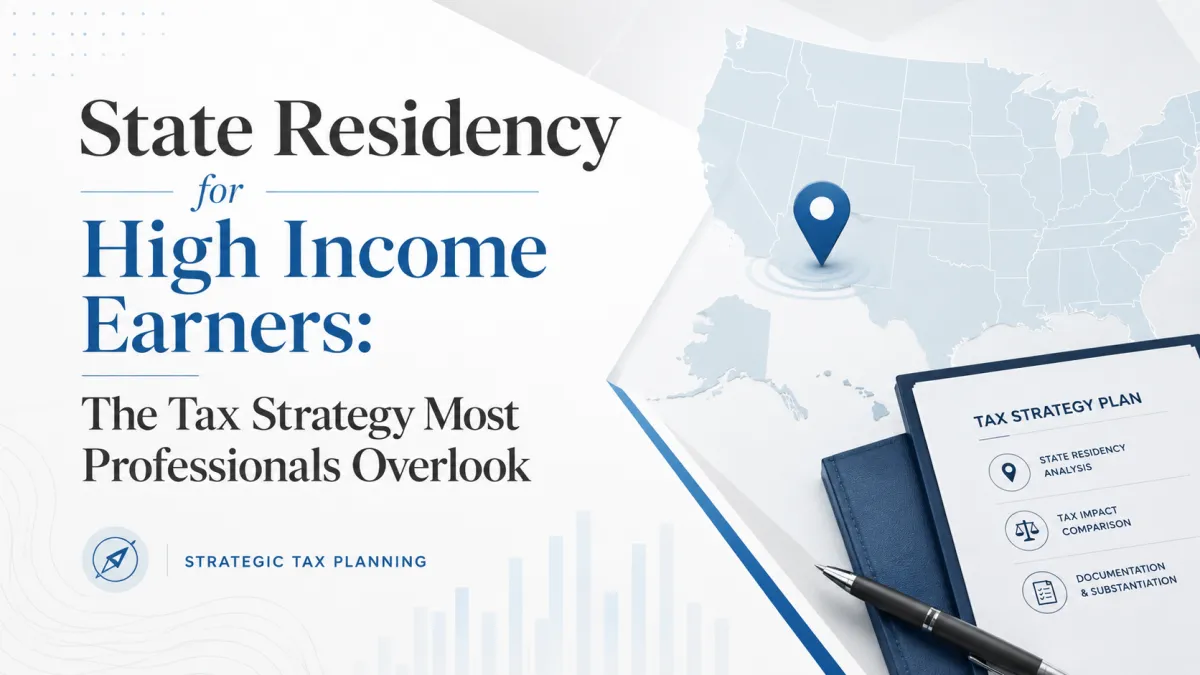
Where You Live Could Be Costing You Thousands: The Strategic Truth About State Residency
If you've relocated in recent years, taken on remote work, expanded your practice across state lines, or even started splitting time between two homes, there's a conversation most professionals don't have until it's too late.
It's the conversation about state residency.
And for high income earners, physicians, practice owners, and entrepreneurs, it has quietly become one of the most consequential, and most overlooked, areas of tax strategy in today's environment.
The Shift That Changed Everything
Over the past several years, we've witnessed a significant migration of high net worth individuals from high tax states to lower tax states like Florida, Texas, Tennessee, and Nevada. Combined with the rise of remote work and multi state operations, the way successful professionals earn, live, and pay taxes has fundamentally shifted.
But here's what most don't realize: the states are paying close attention.
Forty two states impose some form of individual income tax, with rates varying widely and rules constantly refining. As more people move or operate across state lines, state authorities have responded with increased enforcement, more sophisticated audit procedures, and a sharper focus on residency disputes.
If your strategy was built around a change of address and a new driver's license, it isn't a strategy. It's a vulnerability.
Residency vs. Domicile: Why the Distinction Matters
This is where many high earners are caught off guard.
Domicile is your permanent, fixed home, the place you intend to return to no matter how often you travel.
Residency can be created simply by spending enough time in a state, regardless of intent.
You can be domiciled in Florida and still be considered a resident of another state for tax purposes, meaning your worldwide income could be exposed to taxation in a place you thought you'd left behind.
The burden of proving residency change generally falls on the taxpayer. That means every detail matters.
The Four Pillars of a Defensible Residency Strategy
When I work with high income clients, we focus on four essentials. These aren't optional. They're the foundation.
1. Documentation. Driver's license, voter registration, vehicle titles, primary banking and credit relationships, healthcare providers, mailing address, and community ties. States look at the entire picture, not isolated documents.
2. Intent. Intent must be reflected through action: physical presence, the relationships you maintain, the ties you close in your previous state, and the ones you create in your new one.
3. Timing. The dates surrounding your move, when ties are severed, and when new ones are formed can determine which state taxes which portion of your income.
4. Structure. For business owners and those with passthrough or self employment income, entity structure and income allocation are powerful strategic tools, when applied proactively.
Strong residency planning is built on all four. A gap in any one of them is where disputes begin.
Real World Scenarios Worth Considering
A physician practicing across multiple states through telehealth or locum work, unaware that earned income is generally taxable where it's performed.
A practice owner relocating mid year while continuing to operate in their original state.
A high earner with a vacation home in a low tax state, but with the majority of life still tied to the original state.
An entrepreneur with passthrough income flowing from several states, each with its own filing requirements.
In every example, the intention is right. The execution is what determines the outcome.
Why Proactive Planning Wins
State residency planning isn't something you handle in April. It's a year round discipline built into your broader tax and wealth strategy.
Done right, it can support your lifestyle, protect your income, and create long term clarity.
Done reactively, it can lead to dual taxation, audits, and tax bills that erode years of disciplined wealth building.
The high earners I serve don't leave this to chance. They build their residency strategy with the same intention they bring to their careers, practices, and businesses.
Ready to Build a Strategy That Protects What You've Built?
If you've relocated, are planning to, or operate across multiple states, now is the time to align your residency strategy with your financial goals.
Strategic tax planning isn't about reacting to the rules. It's about positioning yourself within them, intentionally and confidently.
👉 Book your Discovery Call with Sharon Eason today
Let's build a residency strategy that works as hard as you do.







Schedule your call today at
(866) 721-5356



ASK QUESTION

SEND A FILE

SUBSCRIBE
Fill out this form and let us know how we can be of service.
We will offer you a complimentary consultation to determine how we can best serve you.





Ready to Keep More of What You Earn?
Start With Tax Savings Assessment
Discover how much you could be saving with proper tax strategy. Our complimentary assessment typically uncovers $30,000-$50,000 in missed deductions and savings opportunities.

© 2024 Chase Eason & Associates, Inc.
100 South Bedford Road, Suite 340, Mt. Kisco, New York 10549